Field, Ford and Green: Reading English Place-Name Clues
English place-name clues can suggest fields, crossings and shared land; learn to compare word elements with maps and local records without overclaiming origins.
What can a name like Greenfield, Oxford or Ashford tell you about the place—and what can’t it tell you? English place-name clues such as field, ford and green can suggest features of the landscape or how people used it. They are starting points for enquiry, not proof of a name’s complete origin.
A useful way to read them is to keep three things in view: the element’s possible meaning, the physical setting and the name’s recorded forms. That last part matters because place names change in spelling and sound over time. A familiar modern word may not be the right guide to an older name.
Start with the element, not a firm conclusion
A place name may contain two or more elements. One can describe a feature, while another may point to a person, settlement or local circumstance. The parts are often joined or altered, so dividing a modern name by eye can be misleading.
Take field. It commonly suggests open or cultivated land, but it does not by itself tell you whether the land was pasture, arable ground, an enclosure or simply an open area as understood when the name arose. Nor does it prove that today’s built-up place once had a particular field in precisely the spot you might expect.
Ford refers to a place where a stream or river could be crossed. The clue can direct attention to a watercourse and possible crossing point. It cannot establish that the current bridge stands on the old crossing, or that the crossing was usable in every season.
Green may suggest an area of grass or shared open ground associated with a settlement. Yet the word can have different histories in different names. A green in a village’s centre is a plausible clue to communal space, not confirmation of how land rights or use worked there.
These are broad associations rather than a complete dictionary of English name elements. The form of a word within a compound can differ from its standalone form, and an element may have more than one possible interpretation. Keep a question mark beside an early reading until the other evidence has had its say.
Compare recurring clues with the visible landscape
Look at the place itself and its surroundings before deciding that a name describes a feature still visible. An Ordnance Survey map can show streams, contours, paths and settlement patterns. A local footpath map may help you understand how a route meets a watercourse or open space. Neither map, on its own, explains what a name meant when it was first used.
Compare like with like. If a group of names includes ford, ask whether each one lies near a stream or river, rather than assuming all refer to the same kind of crossing. For field, notice whether the name sits beside open land, survives within a later suburb, or appears as part of a larger settlement name. For green, check whether there is an open area, but also allow for the possibility that the original feature has been built over or altered.
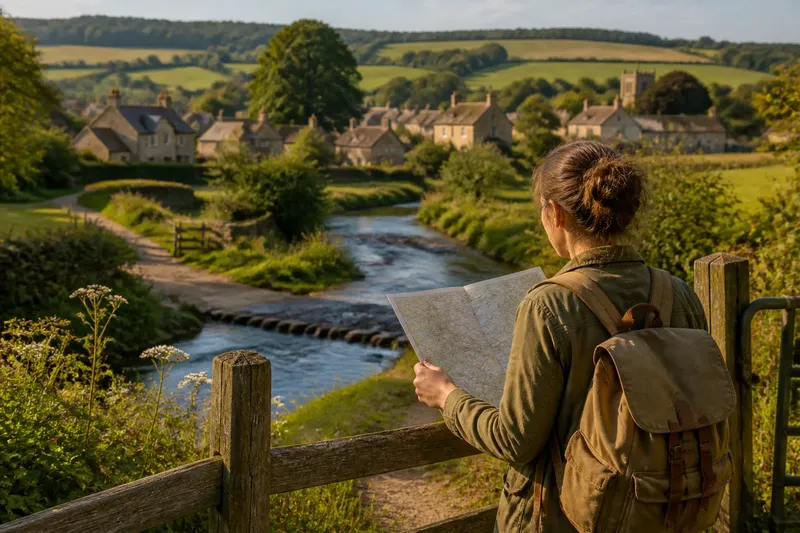
Say you are looking at the invented village of Merefield, where a footpath approaches a small stream near the edge of the built-up area. You could note that the name includes field, mark the stream and path on a map, then check an older map for changes in the settlement’s shape. The expected observable result is a clearer list of relationships between the name and mapped features—not proof that the modern streamside was the original field or that the name describes it exactly.
Use a modest set of observations rather than trying to make every name fit. A place name may preserve a feature that has disappeared; conversely, a feature that seems to match may be unrelated to the name. Recording both possibilities helps prevent a map from turning a promising clue into a settled story.
Use older forms to test a modern reading
For a stronger interpretation, look for historical spellings. County histories, parish records, old maps and place-name reference works may preserve forms that differ from the name used today. Those differences can show why a modern element is not necessarily the original one. A spelling that looks transparent now might have developed from an older form with a less obvious meaning.
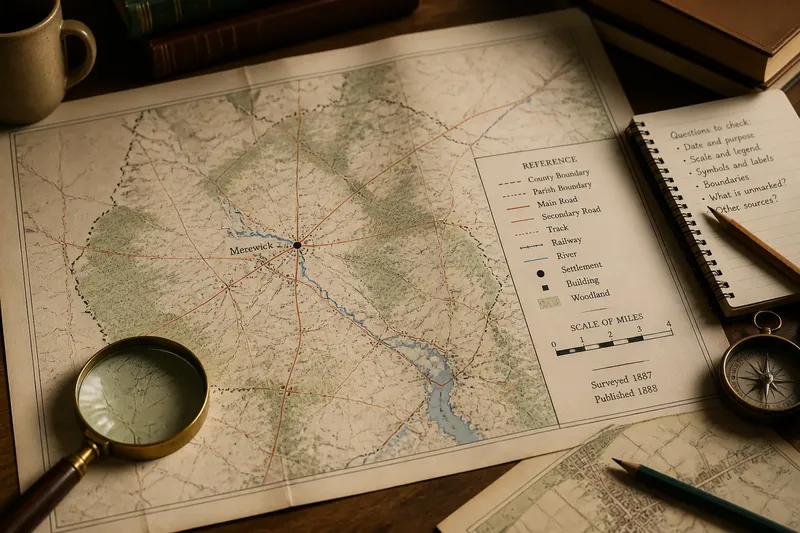
Start locally. A county record office or local studies library may hold historic maps, parish material and printed gazetteers. Catalogue descriptions can help identify relevant collections, while a librarian or archivist may suggest where a particular place is likely to appear. A map is especially useful for tracing changes in roads, streams and settlement edges; written records may show how a name was spelt in a specific context.
When you compare forms, note the source and date as given in the record, and copy the spelling accurately. Avoid silently modernising it. Then ask whether the proposed element can plausibly account for the variation, rather than choosing the spelling that best matches a landscape feature you already noticed.
Some names remain uncertain even after careful comparison. That is not a failure. A cautious note such as “possibly related to a crossing” is more informative than a confident explanation that the surviving evidence cannot support.
What can field, ford and green tell you?
Does field always mean farmland?
No. It can point towards open or cultivated ground, but the name alone does not identify the land’s exact use or location. Check older spellings and local records before treating a present-day field as the source.
Does ford mean there was a crossing nearby?
It is a useful clue to a possible river or stream crossing. The watercourse may have shifted, the crossing may have vanished, or the modern name may not preserve the feature in the way it first appears to.
Does green always mean common land?
Not necessarily. The word can suggest grass or open ground, but a name by itself cannot establish who owned or used that ground. Look for local records if the question concerns historical rights or land use.
How can I check whether a name element is genuine?
Compare recorded forms in a reliable place-name reference with forms found in maps or local records. If the element’s history is disputed or unclear, present it as a possibility rather than a settled origin.
Keep the interpretation tied to its evidence
A useful place-name note separates what you can observe from what you infer. You might write that a name contains an element commonly associated with a crossing, that a stream is shown nearby on a particular map, and that an older spelling needs checking. Each statement has a different level of certainty.
Where records conflict, keep the alternatives visible. A parish history may repeat a traditional explanation, while an older spelling points towards another possibility. The discrepancy is worth noting; it is not a reason to select whichever account makes the neatest landscape story.
For names in English counties, field, ford and green make useful search clues because they encourage you to look for open land, crossings and shared spaces. Use them to frame questions, then test those questions against maps and documentary forms. The most trustworthy reading is often the one that says exactly what the evidence supports—and leaves the rest open.